
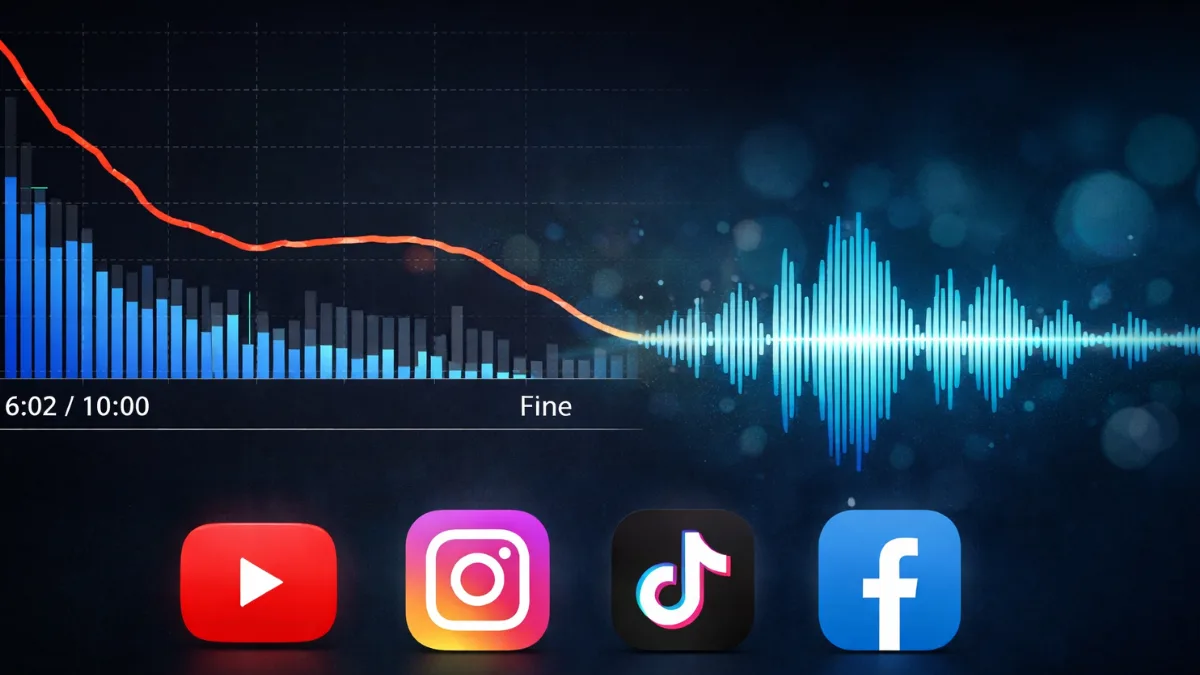
Does Background Music Really Increase Watch Time? Psychology and Retention Strategies
Does Background Music Really Increase Watch Time? Psychology and Retention Strategies
Does background music really increase the watch time of a video? Or is it simply an “enhancement” that makes content more pleasant?
This question matters to creators, editors, agencies, and anyone publishing on YouTube, TikTok, Instagram, online courses, or promotional videos. Today, watch time and retention are not just metrics: they are signals that determine whether a video gets pushed by the algorithm or fades away after a few hours.
What is often underestimated is that music does not act only on emotion in a conscious way. Very often it operates at a subconscious level: it influences attention, time perception, smoothness, tolerance to silence, and even how viewers interpret the creator’s intentions.
In this article, we explore why music can increase watch time and how to use it strategically. Not with generic advice like “choose nice music,” but with a practical logic: what happens inside the viewer’s brain and which choices truly increase the probability that they stay until the end.
1) Audio and Image: The Brain Fuses Them Into a Single Experience
When we watch a video, we are not simply “seeing” and “hearing.” We are constructing a unified experience. The brain constantly integrates visual and auditory information to create a coherent perception of what is happening.
In practice, music can become a temporal structure that organizes everything else: cuts, transitions, speech rhythm, on-screen movement, and even perceived professionalism. That is why two identical videos, with the same editing and same words, can feel completely different depending on the soundtrack.
Music, especially when continuous and well-balanced, reduces the “work” the brain must do to interpret the flow. In simple terms: the viewer feels guided. And when people feel guided, they tend to stay longer.
On the other hand, a video without music (or with incoherent music) can create micro-sensations of discontinuity: pauses that feel empty, scene changes that feel abrupt, or moments where viewers subconsciously think “nothing is really happening.” Those micro-moments, combined, increase the likelihood of abandonment.
An example of audio used in cinema to immerse and maintain attention:

2) Prediction and Attention: Music Prepares the Brain to “Stay”
One of the most fascinating mechanisms of perception is that the brain operates through prediction. It does not wait for something to happen before reacting; it tries to anticipate it.
Music is a powerful generator of predictions: intros, build-ups, pauses, restarts, accents. Even without consciously knowing a track, the brain recognizes rhythmic and harmonic patterns and uses them to anticipate what may happen next.
This anticipation creates a sense of “continuity” and “direction.” The viewer feels that the video is going somewhere. And this is crucial for watch time: people abandon content more easily when it feels static or random.
A good background track, especially if it has even a minimal progression, gives the impression that the video has structure—even when the content is simple (a tutorial, unboxing, vlog, or explanation video).
3) Rhythm, Synchronization, and Micro-Rewards (Dopamine)
When a video cut or transition happens exactly on a musical accent, viewers experience a micro-satisfaction. It is not magic—it is a neurological response linked to pattern recognition and confirmation of prediction.
The brain enjoys when elements align. It is the same reason why a well-timed musical drop feels so satisfying.
These micro-rewards can significantly support retention because they transform an ordinary video into a smoother, more coherent, and more engaging experience. Even if viewers cannot explain it, they perceive it as “better made.”
The key point: you do not need “loud” music. You need music that supports the rhythm of the edit. In some cases, light percussion, a minimal groove, or a soft ambient pad with subtle accents is enough.

4) Silence, Gaps, and Cognitive Load: Why Some Videos Push Viewers Away
Silence can be powerful artistically. But in fast digital content, unintentional silence is often perceived as emptiness.
When viewers sense a gap—even half a second—they may interpret it as “nothing is happening.” That micro-moment is often when they scroll away.
Background music reduces this perception by creating continuity even when:
- the speaker pauses
- the camera angle changes
- visual rhythm slows down
- there is a hard cut
Practically speaking: music lowers the perception of “voids.” Fewer perceived voids mean higher chances of viewers continuing.
5) BPM and Time Perception: The Same Video Can Feel Shorter
One of the most interesting aspects is the relationship between BPM and perceived time. This does not mean BPM “tricks” the brain. It means it changes the sensation of speed, which influences perceived duration.
With higher BPM, viewers often perceive the flow as faster and more dynamic. With lower BPM, the flow feels calmer—and sometimes longer.
This matters because a video that “feels shorter” is more likely to be completed. And higher completion rates often lead to:
- better average retention
- more homepage recommendations
- greater probability of being suggested as “next video”
Practical rule:
- Talking tutorials: moderate or low BPM, minimal music
- Product reveals / ads / montage: medium-high BPM with clear accents
- Gaming / action: high BPM, recognizable rhythmic patterns
- Emotional content: lower BPM, gradual progressions
6) Practical Case: The Same Tutorial, Perceived Differently (With Music)

Imagine an 8-minute tutorial explaining a process: editing, makeup, software setup, walkthrough, or step-by-step guide.
Version A: voice only. Natural pauses. No music.
Version B: voice + soft, continuous ambient background music.
In Version A, every pause is “exposed.” The brain perceives it as a potential exit point: “I could stop here.”
In Version B, music creates a continuous layer. Pauses no longer feel empty. The flow feels stable and the experience more “edited,” more professional, and more intentional.
This does not mean music must always be present. It means that when used correctly, it reduces friction points that lead to abandonment.
7) Branding: Music Influences Trust and Perception
Music affects more than watch time. It influences how viewers perceive the creator and the brand.
Consistent musical choices communicate:
- attention to detail
- professionalism
- stylistic coherence
- recognizable identity
When viewers perceive professionalism and coherence, they are more willing to stay, trust, and eventually take action (subscribe, comment, click, purchase).
8) Common Mistakes That Reduce Watch Time (Even With Music)
- Music too loud: competes with voice → fatigue → abandonment
- Music out of context: emotional mismatch → confusion
- Obvious looping: repetition that distracts
- Abrupt cut: truncated ending → unfinished feeling
- Too much energy for calm content: mismatch → irritation
The point is not to add music. It is to add the right music, calibrated for the content and the goal (watch time).
9) Practical Checklist: How to Choose Music to Increase Retention
- Define the dominant emotion (calm, energy, tension, trust)
- Choose BPM aligned with video rhythm
- Minimize frequencies that compete with the voice
- Use subtle progression to create “direction”
- Synchronize 3–5 key moments with musical accents
- Avoid abrupt endings; use a clean outro
Conclusion
Background music is not a decorative accessory. It is an invisible structure that can guide attention, reduce cognitive load, smooth the flow, and alter time perception.
There is no mathematical guarantee that “adding music = +X% watch time.” However, there are real psychological and perceptual mechanisms explaining why, all else being equal, a video with well-chosen music tends to retain viewers better.
In a digital ecosystem where algorithms reward retention, this choice can become a competitive advantage.